
What makes Hamilton County different is how often the ground itself is the reason. A field that fails in deep, well-drained soil can often be rebuilt in the same footprint. A field that fails in 30 inches of clay over limestone, or on a sandstone bench on Signal Mountain, may need a different kind of system, and only an inspection and a permit design can say which.
Septic Pumping Chattanooga is a free quote service. We connect Chattanooga-area homeowners with independent local septic pumping, inspection and repair companies for free, no-obligation quotes. We do not design or perform repairs. This article is general information, not legal advice.
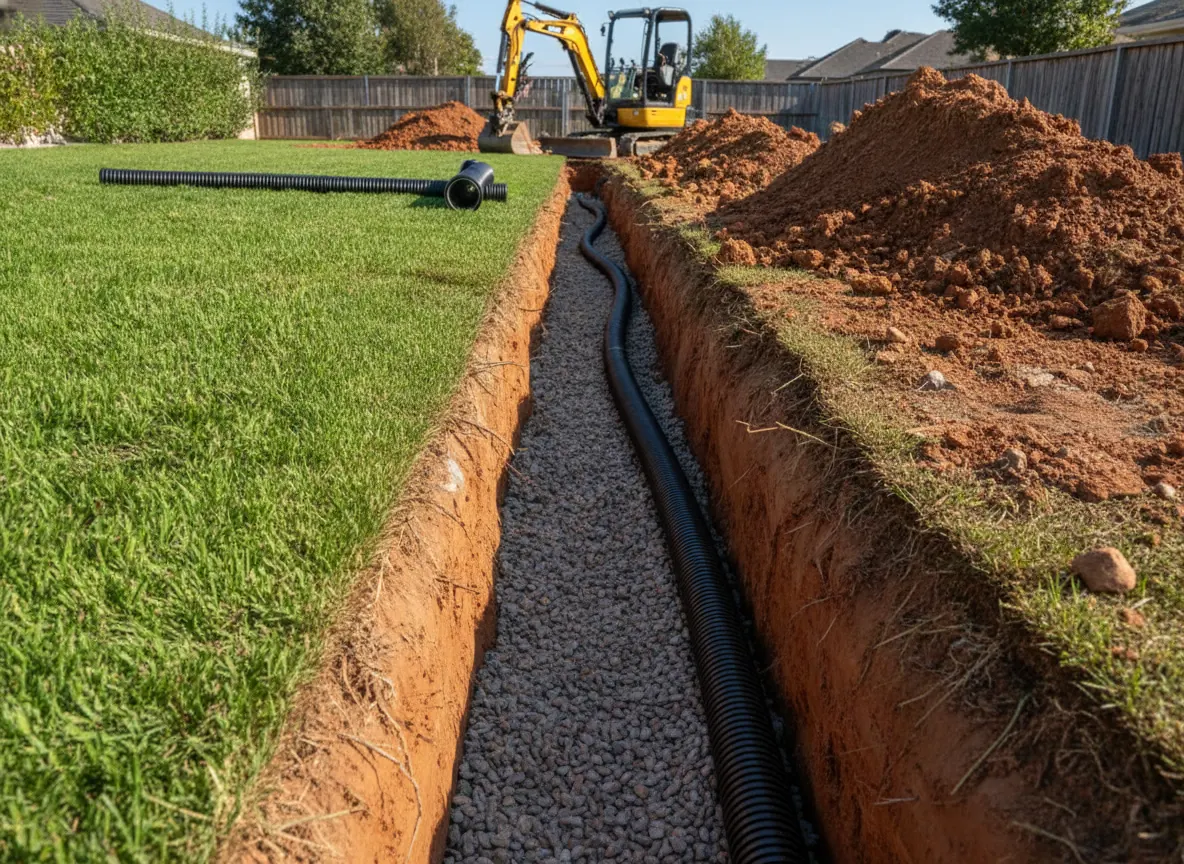
Two kinds of ground, one county
Hamilton County straddles two physiographic provinces. East of the Tennessee River is the Ridge and Valley: northeast-trending belts of Paleozoic limestone, shale and cherty residuum West of the river, Walden Ridge (Signal Mountain) and Lookout Mountain are the edge of the Cumberland Plateau, capped by Pennsylvanian sandstone and shale now mapped as the Crab Orchard Mountains Group.
Valley clay. The NRCS soil series descriptions explain most of the trouble in Ooltewah, Apison, Collegedale and Harrison. The Talbott series is "clayey residuum weathered from limestone" with "moderately slow permeability" and only 20 to 40 inches of soil over bedrock; some areas have karst topography. The Collegedale series, whose type location is 1.5 miles northeast of Collegedale on Tallant Road, is clay or silty clay from limestone and shale, also moderately slow, and the NRCS notes that in Hamilton County "a fairly large acreage has been used for urban development."
Plateau rock. On Signal Mountain and Lookout Mountain, the sandstone caprock is close to the surface. WWTA has said its $40 million Signal Mountain sewer remediation is complicated "due to the underlying rock."
Karst. UTC geologist Amy Brock-Hon has said of the Chattanooga area, "You can say this is a region that is prone to sinkhole development," with sinkholes forming as acidic water dissolves bedrock. Local news documented sinkholes on Shallowford Road and Signal Mountain in January 2013 and Hickory Valley Road in June 2012. A drain field over a void does not treat anything; it drains straight to groundwater.
What the rules require of a field
TDEC Chapter 0400-48-01 sets the design limits. Rule .07 accepts percolation rates of 10 through 75 minutes per inch. Rule .03 requires each lot to hold the original disposal field plus a duplicate area, both sized for a conventional 36-inch trench system unless an alternative system is used. TDEC separately endorses installers for alternative systems such as low-pressure pipe, mound and drip. When a lot cannot meet the conventional numbers, those alternatives are what a permit design turns to, and they cost more: HomeAdvisor (2026) puts a mound system at roughly $15,000 against $3,000–$8,000 for a conventional one.
Signs a drain field is failing
- Drains slow down or gurgle throughout the house, not just at one fixture, and the problem is worse after rain.
- The grass over the trenches is noticeably greener or spongier than the rest of the yard, or there is standing liquid or a persistent odor over the field.
- A new depression or soft spot appears over the field or tank. In this county that can also be a sinkhole question.
None of these alone proves the field has failed. A clogged effluent filter, a broken distribution box, a root-blocked lateral or a tank that simply needs pumping can produce the same symptoms. An inspection determines which, and Tennessee's consumer protection law (TCA 47-18-104(b)(13)) makes it unlawful to represent that a repair is needed when it is not, so ask for the finding in writing.
Repair versus replacement: typical ranges
| Item | Typical range |
|---|---|
| Septic inspection: standard / with camera | $100–$200 / $250–$1,175 |
| Baffle repair | $300–$900 |
| Pipe or lateral line repair | about $600 / $1,500–$5,000 |
| Soil fracturing | $1,000–$2,000 |
| Drain field repair or replacement | $5,000–$12,000 (about $7,000 typical; up to $20,000) |
| Hamilton County fees (government, not contractor) | repair permit $40; new-system permit $440; Inspection Letter $105 |
Typical national ranges from Fixr (2025) and HomeAdvisor (2026) — estimates, not quotes.
The drain field repair page explains what each approach involves; the cost guide has the full table.
Who can legally do the work
Tennessee requires two permits for a field repair, held by two different people.
The contractor's installer permit
TDEC Rule 0400-48-01-.19(1)(a): "No person shall engage in the business of constructing, installing, altering or extending or repairing a subsurface sewage disposal system unless he has a valid annual permit issued by the Commissioner." Hamilton County, a TDEC "contract county," also requires a County Septic Installer License.
The owner's repair permit
Rule .06(3): "Repair permits are necessary when installing tanks (septic or dosing) and/or installing absorption field line in order to correct an existing failure." TDEC says the permit must be issued before any work on a failing system begins, and the regulator designs the repair. In Hamilton County the permit comes from the Division of Groundwater Protection (1250 Market St, Suite 3046; 423-209-7876) and costs $40. County Resolution 423-28 doubles the fees for work started without a permit.
The contractor-licensing thresholds
Separately, a job of $25,000 or more requires a Tennessee contractor license (TCA 62-6-102), and the state's Home Improvement license applies to residential work from $3,000 to under $25,000 in Hamilton and Bradley counties. No septic-specific exemption was found, but this point is unconfirmed for septic work.
Before signing, ask for the TDEC installer permit number and the county license, and check them on the TDEC Installers & Pumpers DataViewer and Hamilton County's 2026 "List of Septic Installers and Pumpers." The regulator guide covers who does what, including TDEC's field office for Bradley County.
Why the location changes the answer
In Ooltewah, 57.1 percent of homes were built in 2000 or later (ACS 2024 5-year, ZIP code 37363), so most fields are young and failures tend to trace to loading, traffic or an unpumped tank rather than age. In Apison, lots are large and the valley clays and shale the town is named for are what a soil map will show. On Signal Mountain, homes have a median year built of 1977 (ACS 2024 5-year, town) and sit on sandstone, where the question is often not whether the field can be rebuilt but where. The permit design, not the contractor's first look, settles that.
Frequently asked questions
Why do drain fields fail in Hamilton County?
The common local reasons are soil and water. Valley soils such as the Talbott and Collegedale series are clay over limestone with moderately slow permeability, and Talbott is only 20 to 40 inches to rock. Add 20.6 inches of rain between December and March, and fields built at the slow end of the 10-to-75-minute-per-inch rule sit saturated for weeks. Age, solids carried over from an unpumped tank, roots and vehicle traffic finish the job.
Can a drain field be repaired, or does it have to be replaced?
It depends on what an inspection finds. A crushed or root-blocked lateral, a failed distribution box or a clogged outlet can be repaired, with national ranges of about $1,500 to $5,000 for lateral line work. A field whose soil has sealed with biomat generally means new absorption lines, which runs $5,000 to $12,000 nationally and up to $20,000. Ask for the written finding and the permit design before deciding.
Who is allowed to repair a drain field in Tennessee?
Under TDEC Rule 0400-48-01-.19, anyone in the business of repairing, altering or installing a septic system needs a TDEC installer permit, and Hamilton County requires its own installer license on top. The homeowner also needs a repair permit, which in Hamilton County comes from the Division of Groundwater Protection for $40. Fees are doubled for work started without a permit. Both the TDEC DataViewer and the county's 2026 list are public.
Do I have to disclose a sinkhole or a failed perc test when I sell?
Yes. Tennessee Code 66-5-212 requires a seller to disclose, before entering a contract, the results of any known percolation test or soil absorption rate accepted by TDEC, and the presence of a known sinkhole on the property as indicated on the recorded plat. The Residential Property Disclosure form also asks about sewer and septic defects. Keep the repair permit and final approval with the house papers. This is general information, not legal advice.
Get quotes from permitted installers
If your field is showing the signs above, start with an inspection, not a dig. A free, no-obligation quote request takes about a minute; describe the symptoms, the age of the system and your part of the county, and independent local companies can quote the inspection and any permitted repair it calls for. We usually reply the same day. You can also call: Call (727) 300-6656.