
"Can you have a septic tank in city limits?" is one of the most common septic questions typed into Google, and in Chattanooga it has a two-part answer. For a new system, Tennessee's rule is clear: no permit where a public sewer is accessible. For an existing tank, the rules we found do not say you must abandon it, and whether a mandatory sewer connection applies to your parcel was not something we researched. What we can map is the geography: who runs sewer where in Hamilton County, where the gaps are, and how to find out which side of the line your house sits on.
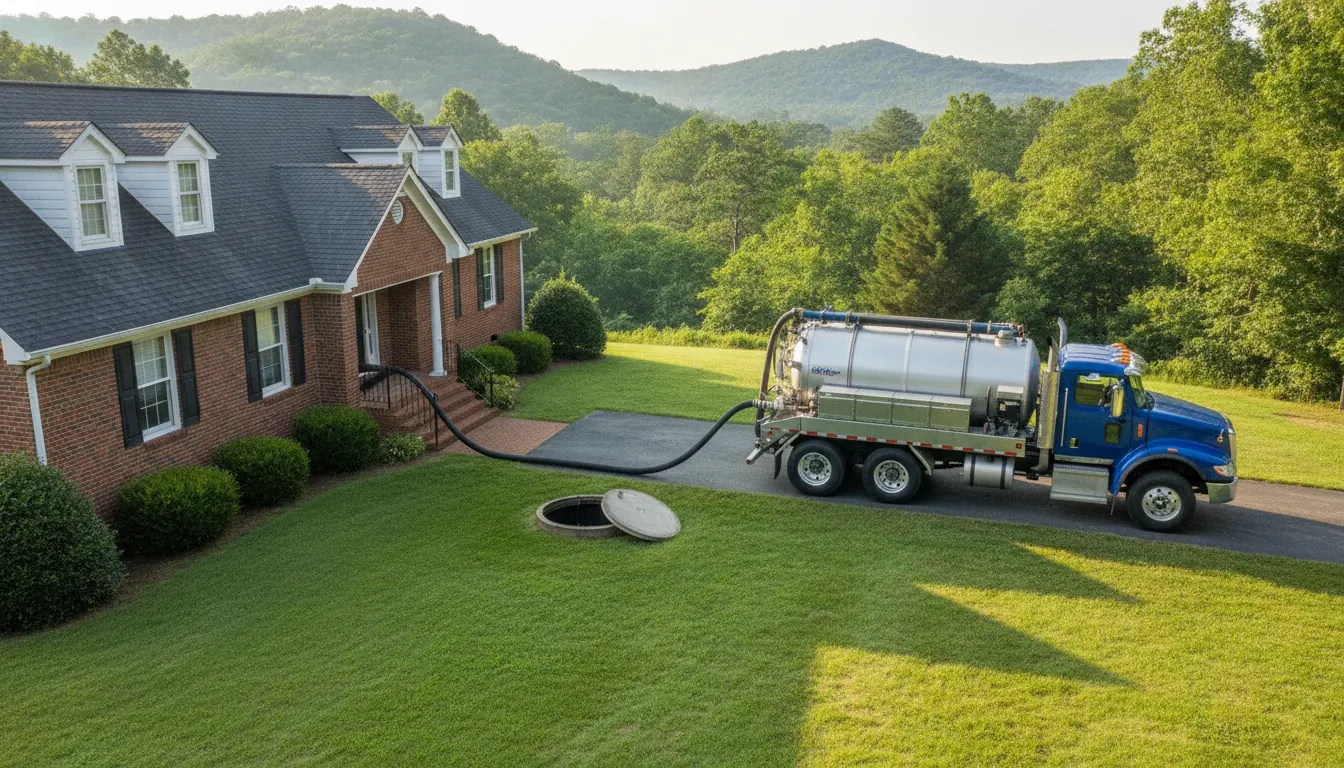
The rule for new systems
TDEC Rule 0400-48-01-.06(2) states that the Commissioner "shall refuse to grant a permit for the construction of a subsurface sewage disposal system where there is an accessible public sewerage system." That applies statewide, inside or outside any city limit, and Hamilton County's Division of Groundwater Protection enforces it locally as a TDEC contract county. So the question for a new build is not "am I in the city?" but "is a public sewer accessible to this lot?" The county's own septic page points people to the Hamilton County Water and Wastewater Treatment Authority (WWTA) at (423) 209-7842 for "sewer line (street connection) information."
Existing tanks inside the city
Plenty of homes inside Chattanooga's corporate limits were built on septic before sewer arrived, especially in annexed areas. Hixson was settled around 1821 and annexed later; East Brainerd and parts of Ooltewah came in the same way. Nothing in Rule 0400-48-01 requires a working system to be abandoned because a sewer line was later extended, and the owner's duty under Rule .13 to "maintain the system in a safe and sanitary manner" continues as long as the tank is in use. What we did not research, and therefore will not guess at, is whether the City of Chattanooga or WWTA has a connection mandate when a septic system fails near an available sewer. If your system is failing and a main runs down your street, ask both Groundwater Protection and the sewer provider before paying for a repair design.
Who runs sewer where
City of Chattanooga: Moccasin Bend
Chattanooga's interceptor system drains to the Moccasin Bend Environmental Campus, which averages around 70 million gallons a day and serves "more than 400,000 residents" across a roughly 500-square-mile collection area through more than 1,200 miles of pipe and 80 pump stations. Nine regional customers outside city limits send flow to it, Collegedale among them. Inside the city of 185,783 people (ACS 2024 5-year), annexed neighborhoods such as Hixson and East Brainerd are generally on this system, but fringe pockets may be WWTA or septic, and only a parcel-level check settles it.
WWTA: the unincorporated county and seven municipalities
WWTA was created by the County Commission in 1993 under TCA 68-221-601. It runs sewer "throughout the unincorporated areas of Hamilton County" plus East Ridge, Lakesite, Lookout Mountain, Red Bank, Ridgeside, Signal Mountain and Soddy Daisy, and it says it is "not responsible for sewers in the City of Collegedale, the Town of Walden or the City of Chattanooga." Its own figures: "over 30,000 sewer customers," "over 500 miles of collection lines, 60 pump stations, 900 grinder pumps, 2 wastewater treatment facilities" (the Signal Mountain plant and the Wild Ridge recirculating plant).
Collegedale: its own pipes, Chattanooga's plant
Collegedale operates a city collection system of 32.2 miles of gravity sewer, 842 manholes and three pump stations that discharges into Chattanooga's interceptor at the Collegedale Pump Station. The city reports "1,200 customer accounts" for a population of over 12,000. Against 4,304 occupied housing units (ACS 2024 5-year), that number suggests many Collegedale households are not on city sewer, but accounts are not households (the university and apartment complexes may be master-metered), so treat it as a hint, not a septic count. Our Collegedale page has the housing detail.
How big is the septic population? Nobody has published it
No TDEC, county or WWTA document gives a count of septic systems in Hamilton County, and the "20,000 systems" figure that surfaces in searches belongs to Hamilton County, Ohio. The only scale indicators are proxies: WWTA's 30,000-plus customers set against the county's 154,181 occupied housing units (ACS 2024 5-year), with Chattanooga's city system covering most of the remainder. Those denominators do not match (customers are accounts, and the city system also serves nine outside jurisdictions), so the arithmetic yields a ceiling, not a percentage. What the sources do support is a geography: a 2025 county commission discussion described the unincorporated county as "predominately" without sewers, and the places where septic dominates are the eastern growth corridor (Ooltewah, Harrison, Apison), the north end along US 27 (Soddy-Daisy's ridge and lake lots, Sale Creek) and the plateau towns of Walden Ridge.
The Ooltewah moratorium: when neither option was available
The clearest illustration of the sewer-versus-septic squeeze happened in eastern Hamilton County in 2018 and 2019. After WWTA's Ooltewah-area system recorded 29 sanitary sewer overflows from October 2017 onward, releasing about 2 million gallons of raw sewage into Rogers Creek in a year, TDEC directed WWTA to halt new sewer tie-ins in parts of the eastern county. A state senator said the county also stopped issuing septic permits in the affected area during that period, so for a time some lots could get neither a sewer tap nor a septic permit. WWTA proposed a $45 million treatment plant on Mahan Gap Road to open a 20,000-acre area to sewer; the County Commission rejected it 6-3 in early 2019, and a bill to allow septic in moratorium areas stalled. We found no source stating when or whether the moratorium was lifted, so anyone building near Ooltewah should ask WWTA and Groundwater Protection directly. In March 2025 the County Commission adopted Resolution 325-17 requiring new onsite (decentralized) wastewater facilities to be built to WWTA standards and transferred to WWTA; that governs subdivision-scale plants, not individual household tanks.
How to find out which one you have
Look at the utility bill
A sewer charge from the City of Chattanooga, WWTA or Collegedale means you are on sewer. No sewer line item is a strong hint you are on septic.
Call the sewer-availability line
WWTA at (423) 209-7842 can say whether a main is accessible to your parcel; inside the city, the City's sewer department is the equivalent call.
Check for a septic permit
Hamilton County Groundwater Protection, (423) 209-7876, holds permits for systems in the county; TDEC's online file search covers Bradley and other non-contract counties.
Walk the yard
Lids, risers or a rectangular area of greener grass are the usual signs. A septic company can locate the tank if the permit sketch is missing; see how a pump-out works.
What it means if you are on septic inside the city
The same rules apply whether your tank sits in Hixson or Harrison: TDEC's Rule 0400-48-01 and Hamilton County's permit office. Pumping is done by companies holding a TDEC Septic Tank Pumping Contractor permit and a county pumper license; repairs need a permitted installer and the owner's $40 county repair permit. The pumper likely discharges your septage at the same Moccasin Bend plant your sewered neighbors drain into, under the city's $100-per-vehicle hauled-waste permit. See who regulates septic in Hamilton County and septic pumping cost.
How this site fits in
Septic Pumping Chattanooga connects Chattanooga-area homeowners with independent local septic pumping, inspection and repair companies for free, no-obligation quotes. We are not a utility and we cannot tell you whether a sewer main reaches your lot; WWTA, the City and Groundwater Protection can. Once you know you are on septic and need a pump-out or inspection, request free quotes; we usually reply the same day.
Frequently asked questions
Can you install a new septic tank inside Chattanooga city limits?
Only where no public sewer is accessible. TDEC Rule 0400-48-01-.06(2) says the Commissioner shall refuse a construction permit where there is an accessible public sewerage system, and Hamilton County Groundwater Protection applies that rule inside and outside the city. Call WWTA's sewer-availability line at (423) 209-7842, or the City for parcels on its system, before applying. This is general information, not legal advice.
Do I have to connect to sewer if my septic system fails in Hamilton County?
We did not research City of Chattanooga or WWTA connection mandates, so we cannot say. The state septic rules we reviewed do not require abandoning a working system when sewer arrives, but a failing system near an accessible main is exactly the case a local ordinance might address. Ask Groundwater Protection at (423) 209-7876 and your sewer provider before paying for a repair design.
How many homes in Hamilton County are on septic?
No published count exists. WWTA reports over 30,000 sewer customers and Collegedale about 1,200 accounts, against 154,181 occupied housing units countywide (ACS 2024 5-year), with Chattanooga's city system serving most of the rest. Because customers are accounts, not households, and the city plant also serves outside jurisdictions, those numbers give a ceiling, not a percentage. The unincorporated county is described as predominantly unsewered.