
Of all the things a septic company can sell a homeowner, a riser is the one with the plainest payback. Companies in this market advertise riser installation but rarely explain the reason to buy one, and some homeowners assume it is a code requirement. It is not.
Septic Pumping Chattanooga is a free quote service. We connect Chattanooga-area homeowners with independent local septic pumping, inspection and repair companies for free, no-obligation quotes. Prices below are typical national ranges, not quotes.
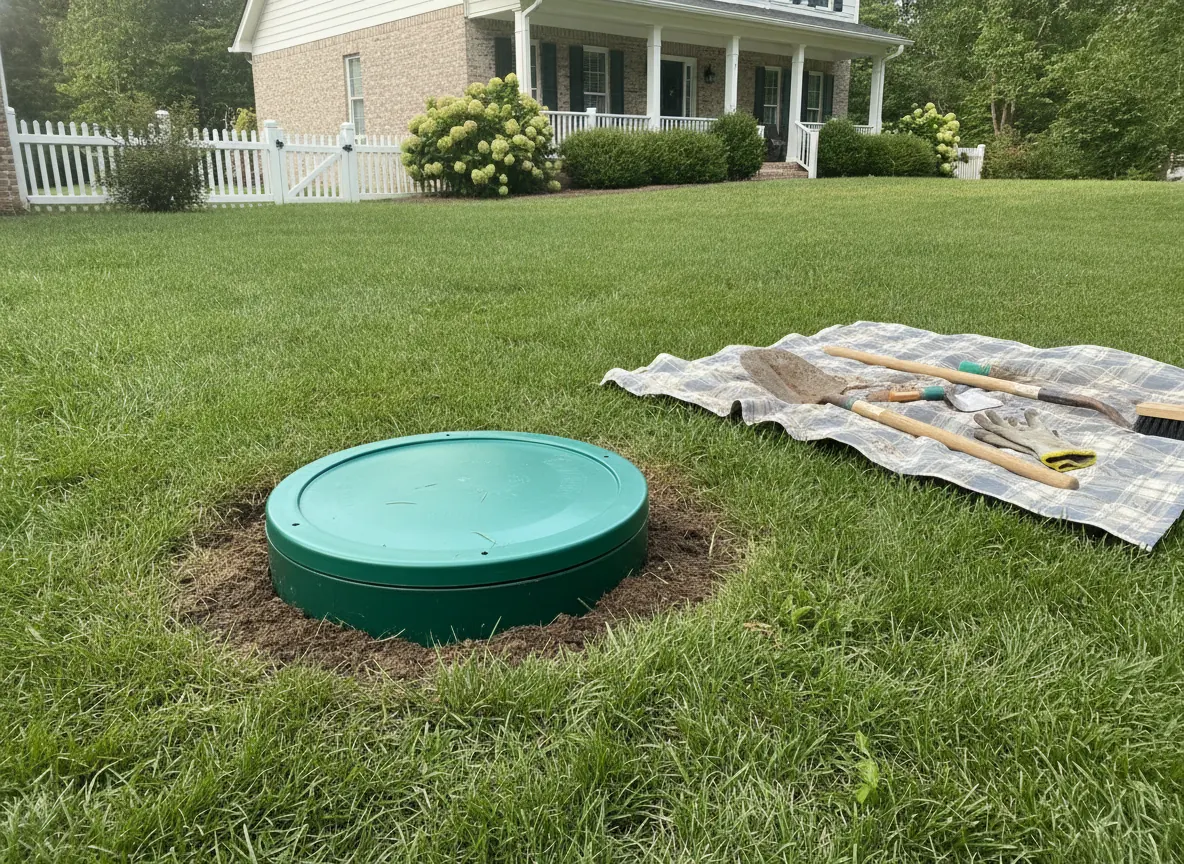
What a riser is and what it does
A septic tank is buried with its top anywhere from a few inches to a few feet below grade. Access is through one or more openings in that top, each covered by a lid, originally a concrete slab and on newer tanks often a bolted plastic cover. A riser is a ring, usually plastic or concrete, sealed to the tank over an opening and stacked to bring the access point up to ground level, where it gets a lockable lid of its own. Once installed, nobody has to find the tank with a probe, dig down to the slab, lift it, and backfill afterward.
The tank gets opened more often than most people think. The EPA says household septic tanks are typically pumped every three to five years and inspected at least every three years. A tank with an effluent filter needs that filter cleaned, which means opening the outlet side. A home sale usually means an inspection.
Why the pump-out is cheaper with one
Pump-out pricing assumes the lid is reachable. Fixr (2025) puts a 750-gallon pump-out at $175–$300, a 1,000-gallon tank at $225–$400, 1,250 gallons at $300–$600 and 1,500 gallons at $345–$600, with its $200 low end explicitly assuming an uncovered lid. Locating and digging a buried lid is an extra line on the invoice; the amount varies by company and by how deep the tank is, so ask for a flat fee rather than an hourly rate. Multiply that digging charge by a pump-out every three to five years, add the filter cleanings and the sale inspection, and a $300–$600 riser typically pays for itself within two or three visits. The process page describes the locating and uncovering stage a riser eliminates.
Why tanks have two or three lids
A typical tank has an opening over the inlet, where the house line enters and sludge accumulates, and one over the outlet, where the baffle or tee keeps scum from leaving and where an effluent filter sits if the tank has one. Two-compartment tanks add a center opening. Pumping is done from the inlet side; checking the outlet baffle and filter needs the outlet side. A riser on only one opening is better than none, but if the pumper still has to dig for the other lid, the saving is halved.
Tennessee has no riser law
The research behind this site reviewed TDEC's septic rules, Chapter 0400-48-01, and found no provision requiring risers on an existing septic tank. The only accessibility language in the chapter is in Rule .14(3), which concerns commercial grease traps: "A cover shall be provided and located so as to be conveniently accessible for servicing and cleaning." Nothing comparable applies to a residential tank, and Hamilton County's program has no riser mandate either. A riser is a decision about cost and convenience, not compliance.
What is less clear is the permit question. TDEC defines an installer as someone who "installs, constructs, alters, or extends" a system, and the construction permit covers "construct, alter, extend or repair." No rule text was found saying whether adding a riser or replacing a lid is an alteration. The safe practice is for the work to be done by a company with a TDEC installer permit that pulls any permit Hamilton County Groundwater Protection requires, and to ask the county directly (423-209-7876) if you want certainty. The owner-exemption guide covers what a homeowner may do personally.
Lids: when to replace, and what it costs
Concrete lids crack, sag and spall with age, and plastic riser lids lose their bolts or seals. A lid that cannot bear weight is a hazard to anyone walking the yard, and a lid that does not seal lets surface water into the tank during the kind of rain described in the heavy rain guide. If a pumper notes a damaged lid, replace it.
| Item | Typical range |
|---|---|
| Riser installation (installed, per riser) | $300–$600 |
| Riser parts only | $100–$200 |
| Lid replacement | $150–$500 |
| Extra for an unknown or buried lid (locating and digging) | varies; ask for a flat fee |
| Effluent filter clean / replace | $100–$200 / $200–$300 |
| Septic tank pumping, by tank size: 750 / 1,000 / 1,250 / 1,500 gal | $175–$300 / $225–$400 / $300–$600 / $345–$600 |
Typical national ranges from Fixr (2025) and HomeAdvisor (2026) — estimates, not quotes. Riser sources disagree by about three times; the lower figure appears to be parts only.
The full table, including inspections and county fees, is on the septic pumping cost page, and the septic repair page covers baffles, filters and pumps alongside lids and risers.
Who buys risers around Chattanooga
Two kinds of homes, for two different reasons. In Ooltewah, 57.1 percent of homes were built in 2000 or later (ACS 2024 5-year, ZIP code 37363). Many of those tanks are reaching their first or second pump-out, and adding risers while the lids are already uncovered is the cheapest moment to do it. In Harrison, 61.4 percent of homes were built between 1970 and 1999 (ACS 2024 5-year, CDP), the highest share in the county, and those tanks have concrete slab lids that are now 30 to 50 years old. There, the riser conversation usually starts with a cracked lid. In either case the best time to install is during a pump-out that is already happening, so ask for the riser price on the same quote as the pumping.
Questions to ask before you buy
- How many openings does my tank have, and which ones will get a riser?
- What is the riser made of, and how is it sealed to the tank top?
- Is the lid lockable or bolted, and rated for foot traffic?
- Does this work need a county permit, and who pulls it?
- What is your TDEC installer permit number and Hamilton County license? (Check the TDEC Installers & Pumpers DataViewer and the county's 2026 list.)
Frequently asked questions
Are septic tank risers a good idea?
For most tanks buried more than a few inches down, yes. A riser brings the access opening to grade so a pumping company can open the tank without locating and digging it, which removes the extra charge for a buried lid on every visit, lets the effluent filter be cleaned, and makes inspections quicker. National installed prices run about $300 to $600 per riser (HomeAdvisor, 2026); parts alone are $100 to $200 (Fixr, 2025).
Why does my septic tank have two or three lids?
Most tanks have an opening over the inlet and one over the outlet, and two-compartment tanks add a third over the center wall. A pump-out is normally done from the lid nearest the inlet, where the sludge sits, and the outlet lid is where the baffle and the effluent filter, if there is one, are checked. If only one lid has a riser, the other side may still need digging at every visit.
Does Tennessee require septic tank risers?
No requirement for risers on an existing tank was found in TDEC's septic rules, Chapter 0400-48-01, and no Hamilton County rule mandates them. The only accessibility language in the chapter is Rule .14(3), which says a grease trap cover must be conveniently accessible for servicing and cleaning. Risers are a convenience and cost decision, not a legal one. Hamilton County Groundwater Protection (423-209-7876) can confirm any permit question.
How much does it cost to replace a septic tank lid?
Lid replacement runs about $150 to $500 nationally (Fixr, 2025, and HomeAdvisor, 2026, agree), with the price depending on whether it is a concrete slab lid or a plastic riser lid and whether the tank has to be dug to reach it. A cracked, sagging or missing lid is a safety issue as well as a maintenance one, so it is worth having looked at during the next pump-out rather than waiting.
Get a riser quote with your next pump-out
A free, no-obligation quote request takes about a minute. Mention that you want a riser price alongside the pumping, and independent local companies can quote both on one visit. We usually reply the same day. You can also call: Call (727) 300-6656.